Charlotte's termite is the eastern subterranean termite, which NC State Extension says can be found in all counties of the state. In North Carolina they typically swarm from late spring to late summer, often on warm, gusty days after rain. Winged termites inside the house are, in Extension's words, most certainly a sign of active infestation.
Key facts
- Species
- Eastern subterranean termite, found in all NC counties
- Formosan termite
- Confirmed only in Brunswick and Rutherford counties (NC State Extension)
- Usual swarm season
- Late spring to late summer, in North Carolina
- Strongest sign
- Swarmers indoors
- Inspection
- $150 to $350, one-time visit, national (Fixr)
Which termite you're dealing with
In Mecklenburg County the answer is almost always the eastern subterranean termite. NC State Extension's biology and behavior guide (January 2025) says it can be found in all counties. Extension's separate Formosan termite page records confirmed Formosan finds in Brunswick County in 1992 and in Spindale, Rutherfordton and Forest City in Rutherford County. It does not report Formosan termites in Mecklenburg.
When swarmers fly
The swarm is the colony sending out winged adults. Extension says that in North Carolina this typically happens on warmer and gusty days, especially after a recent rain, from late spring to late summer. It also notes swarming can come in early spring on particularly warm days, "or even later into the Fall," depending on weather conditions, colony size and maturity, and temperature.
Where you see them matters. Swarmers outdoors near an old stump aren't necessarily a problem for the house. Swarmers indoors are most certainly a sign of active infestation.
Signs to check for
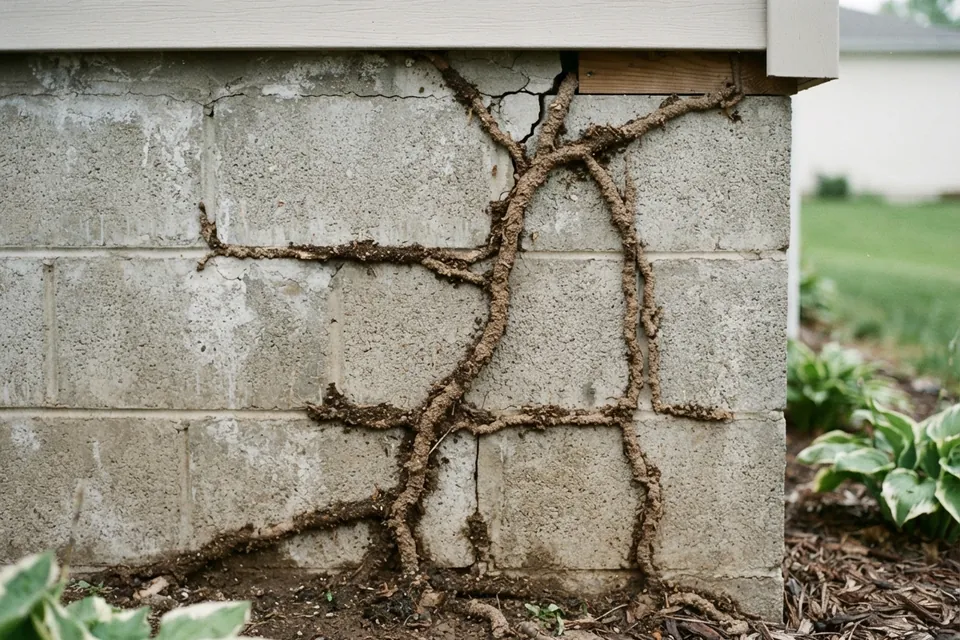
- Mud tubes. The termites build them to cross areas above the soil. Look on foundation walls, behind siding, and in basements and crawlspaces.
- Hollow wood. Wood that sounds hollow when you tap it with the handle of a screwdriver.
- Soft wood. Wood that a knife or screwdriver tip goes into easily.
- Mud in the wood. Mud packed inside a damaged board.
Want a price for your home? Call a local pest control company for a written quote.
Phone line opening soonWhat to do first
- Leave mud tubes and damaged wood as they are. An inspector needs to see them.
- If winged insects are indoors, collect a few in a sealed bag or jar so an inspector can identify them.
- Take photos and note where and when you saw the activity.
- Call a company for an inspection, and check the licensee's name on the NCDA&CS license search before treatment starts.
Don't try to treat termites yourself. If a company uses any product in your home, ask what it is, keep children and pets away as the label directs, and call NC Poison Control at 1-800-222-1222 after an exposure.
What treatment costs
Fixr gives $150 to $350 nationally for a one-time termite inspection, and $450 to $2,000 for treatment. The termite treatment cost page lists what a North Carolina termite agreement must show in writing.
When you call: 4 questions to ask
- Who is the NCDA&CS licensee for my job, and what is the license number?
- Will the technician who comes out be registered with the Division?
- For termites, will I get a written agreement with a foundation diagram and the re-treatment conditions?
- If I'm selling, can your licensee issue the WDIR 100?
A fair written quote shows the pest, the treatment, the areas to be treated, the visit schedule, the total price, any re-inspection or re-treatment terms and how to cancel. Check any contractor's license on the NCDA&CS license search before work starts.
What happens when you call
- You're connectedStraight to a local pest control company that serves your area and takes calls like yours.
- You get a priceDescribe the problem, ask for a written quote and their license number. No obligation.
Common questions
When do termites swarm in Charlotte?
NC State Extension says eastern subterranean termites in North Carolina typically swarm from late spring to late summer, on warmer and gusty days, especially after rain. Swarms can also happen in early spring or later into the fall.
Are winged termites outside a sign my house is infested?
Not necessarily. Swarmers outdoors near stumps don't by themselves point to the house. Swarmers indoors are most certainly a sign of active infestation, according to Extension.
Should I break open mud tubes?
Leave them for the inspector. They are one of the main signs a licensed company will look for.
Does Charlotte have Formosan termites?
NC State Extension doesn't report them in Mecklenburg County. Confirmed finds are in Brunswick and Rutherford counties.
Related guides
Sources
- NC State Extension: Biology and behavior of eastern subterranean termites
- NC State Extension: Formosan termites in North Carolina
- NCDA&CS: Structural Pest Control & Pesticides license search
- North Carolina Poison Control
- Fixr: Termite treatment cost
Costs are typical ranges. Your quote depends on your home. Rules and rebates change; check the original source before you rely on a figure. Something wrong? Tell us via the contact on the Impressum page.