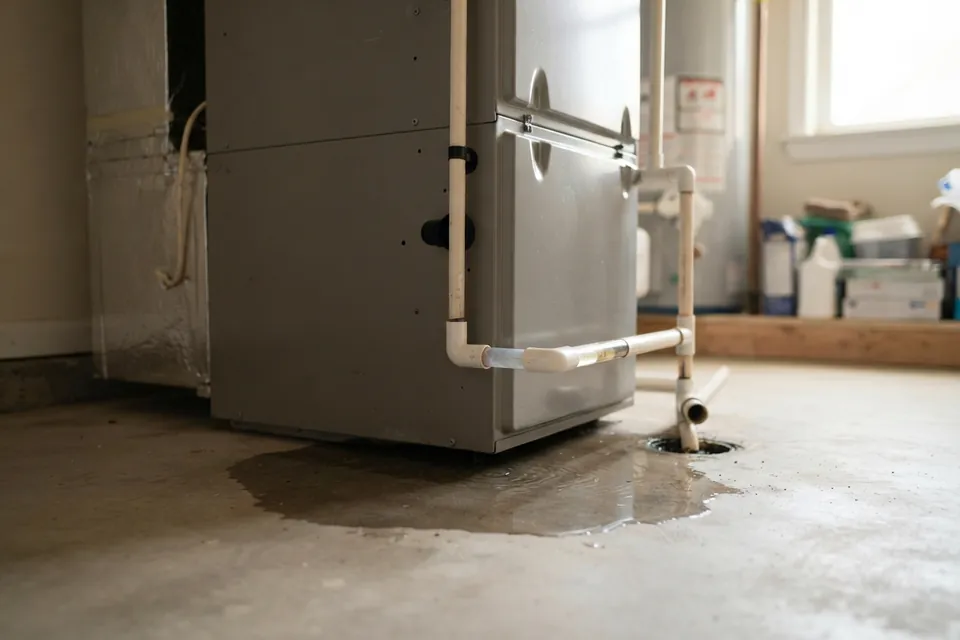
An air conditioner pulls moisture out of indoor air and sends it down a small drain pipe. A puddle means that water is going somewhere else, usually because the drain is blocked or the coil iced over and is now melting. Switch cooling off, soak up what you can, change a dirty filter, and call an air conditioning contractor if the drip resumes when the system restarts.
Key facts
- Is this an emergency?
- Rarely. It becomes one when water reaches wiring or a ceiling starts to sag.
- Can I sort it myself?
- You can stop the drip and limit the mess; clearing the drain inside the unit is a technician's job.
- Who do I need?
- An ACR-licensed air conditioning contractor; a water damage company only if building materials are soaked.
Is this an emergency?
Mostly not. Condensate is clean water arriving slowly, and turning the cooling off stops more of it forming. Two situations raise the stakes. First, water tracking toward an outlet, a power strip or the unit's own wiring: keep clear and cut power to that area at the breaker only if you can do so standing on a dry floor. Second, an attic unit dripping through the ceiling below: a brown ring that grows or a bulge in the drywall means the leak has been going for a while.
Can I sort it myself?
You can do the damage control and one or two simple checks.
- Turn cooling off at the thermostat. No cooling, no new condensate.
- Dry the area. Towels or a wet vacuum on the floor, a bucket under a ceiling drip, boxes and rugs moved out of the way.
- Look at the filter. A clogged one can let the coil freeze, and the thaw overflows the pan. Swap it if it is grey.
- Find the drain outlet outdoors. It is a short plastic pipe near the foundation or under an eave. Brush away mud, mulch or insect nests from the open end with a gloved hand. Go no further up the pipe.
- Check for ice. Frost on the indoor cabinet or the insulated pipe means leave the fan on and the cooling off until it clears.
- Restart and watch. Once everything is dry, run the system and look again after an hour.
Stop and call a pro when
- water shows up again after the restart;
- the unit is in the attic and a ceiling is marked or soft;
- ice keeps forming;
- the system shut itself off and will not start;
- anything electrical got wet.
Want a price for your home? Call a local heating & cooling pro for a written quote.
Phone line opening soonWho do I need?
Start with an air conditioning contractor. The license to ask about is the Texas ACR contractor license, which you can look up by company or number in the TDLR License Data Search. The drain, the pan and the coil are all inside the equipment, so that is where your part ends.
A second company comes in only if drywall, insulation or flooring took on water. Fixr's national average range for water damage restoration is $1,200 to $5,000; it is a national figure because no Dallas figure is available here. Before filing a claim, know how the Texas Department of Insurance describes home policies: most cover a sudden and accidental release of water, and most don't cover a continuous water leak. A drip that ran for weeks falls on the wrong side of that line, which is a reason to deal with a small puddle now.
Dallas details
| Item | What applies in Dallas |
|---|---|
| Why it matters here | The normal July high at DFW International Airport is 95.6 °F. Cooling you had to switch off needs fixing soon. |
| License to ask for | Texas ACR contractor license (TDLR) |
| Permit | Mechanical permit applies to installing, replacing, or modifying HVAC systems (City Planning & Development Guide). The guide gives no line for clearing a drain. |
| Repair price | No local figure; national range below; ask for it in writing |
| Drying out, if needed | $1,200 to $5,000 (national average range, Fixr) |
| Insurance rule of thumb | Sudden and accidental release of water: most policies cover it. Continuous water leak: most policies don't cover it (TDI) |
What a repair usually costs
National ranges from cost publishers, not Dallas quotes. The fault decides the price, so ask for it in writing before work starts.
When you call: 4 questions to ask
- Are you a registered air conditioning contractor with the City of Dallas, and what's your TDLR license number?
- Is the mechanical permit included in this price?
- Will the furnace be 90% or 95% AFUE, and will you file the Atmos Energy rebate?
- What size unit do you recommend, and how did you work that out?
A fair written quote shows the model and efficiency, the permit, rebate paperwork, removal of the old unit, and parts and labor warranty. Check any contractor's license on the TDLR license search before work starts.
What happens when you call
- You're connectedStraight to a local heating & cooling pro that serves your area and takes calls like yours.
- You get a priceDescribe the problem, ask for a written quote and their license number. No obligation.
Common questions
Why is water dripping from my AC unit inside?
Either the condensate drain is blocked and the pan is overflowing, or the coil froze and is thawing. Both start with switching the cooling off.
Can I still run my AC if it is leaking water?
Leave cooling off until the cause is found. Running it makes more condensate, and that water ends up on your floor or ceiling.
Does homeowners insurance cover an AC leak in Texas?
The Texas Department of Insurance says most policies cover a sudden and accidental release of water but not a continuous water leak. Your own policy and insurer decide the claim.
Who fixes an AC drain line in Dallas?
An air conditioning contractor. Ask for the Texas ACR contractor license number and check it in the TDLR License Data Search.
Related guides
Sources
- TDLR: Air Conditioning and Refrigeration at a Glance
- TDLR: License Data Search
- City of Dallas: Planning & Development Guide
- Fixr: Water damage restoration cost
- Texas Department of Insurance: Homeowners insurance guide
- National Weather Service Fort Worth: DFW normals, means and extremes
Costs are typical ranges. Your quote depends on your home. Rules and rebates change; check the original source before you rely on a figure. Something wrong? Tell us via the contact on the Impressum page.