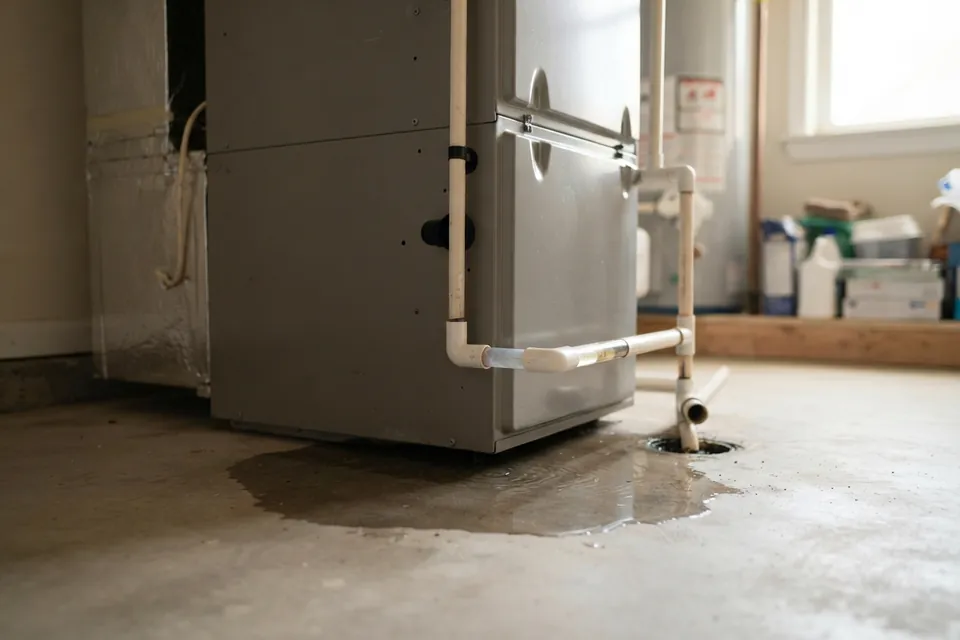
Turn cooling off at the thermostat so the unit stops making condensation, then soak up what has pooled. During the next hour, check the filter, look for ice and see whether the drain pipe outside is dripping. A drain that stays blocked, a rusted pan or repeat icing needs an AC technician. The Texas Department of Insurance separates sudden water releases from continuous leaks, so act early.
Key facts
- First five minutes
- Cooling off, water mopped, electrics kept dry
- Next hour
- Filter, ice, outside drain outlet, ceiling below
- Permit for the fix
- Mechanical permit when equipment is repaired or changed
- License to ask for
- ACR contractor license (TDLR)
- Insurance line
- Sudden and accidental release covered; continuous leak not (TDI)
- If materials got soaked
- $1,200–$5,000 for restoration (Fixr national average range)
First five minutes
- Set the thermostat to Off. An air conditioner wrings moisture out of indoor air whenever it cools. Stop the cooling and you stop new water forming.
- Keep water and electricity apart. If the puddle has reached a power strip, an outlet or the unit's own wiring, stay back and switch off that breaker instead of wading in.
- Mop and catch. Towels on the floor, a pan or bucket under any drip, and plastic over furniture beneath a damp ceiling patch.
- Note where it shows up. Under a closet unit, below an attic unit, or outside at the eaves from a second pipe. The location is the first thing a technician will ask.
Next hour
- Check the filter. A matted filter lets the cooling coil ice over; when the ice melts, the pan can overflow. Replace a dirty one.
- Look for frost without opening anything. Ice on the insulated copper line or on the outside of the indoor casing means leave the system off with the fan set to On until it clears.
- Find the drain outlet outdoors. It is normally a small plastic pipe near the foundation or the outdoor unit. A steady drip while cooling is healthy. Nothing at all, on a day the system has been working hard, points to a clog. Brush away mud or mulch covering the end; go no further than that.
- Watch a second pipe at the eaves. Many attic units have an emergency drain that exits high on the wall or soffit so you notice it. Water from that pipe says the main drain is blocked.
- Inspect the ceiling below an attic unit. A stain that is growing, soft or bowing should be kept clear of people. Enter the attic only if it has solid flooring and good light.
Want a price for your home? Call a local heating & cooling pro for a written quote.
Phone line opening soonDo and don't
| Do | Don't |
|---|---|
| Leave cooling off until the cause is known | Keep running it with a towel underneath |
| Clear dirt from the open end of the outdoor drain pipe | Pour bleach, drain opener or other chemicals into the unit |
| Photograph the puddle and any stain with the date | Unscrew access panels to look at the coil or pan |
| Dry wet carpet and baseboards with fans | Step between attic joists to reach the unit |
Stop and call a pro when
- Water returns as soon as cooling is switched back on.
- The ceiling under the unit is stained, soft or sagging.
- You found ice, and it forms again after a full thaw.
- The system shut itself down and will not restart.
- Water touched wiring, an outlet or the unit's controls.
Before a repair starts
Heavy use, more condensation
The normal July high at the area's official climate station is 95.6 °F. Long run times in that heat mean a drain line carries water for most of the day, so a partial clog that went unnoticed in spring tends to show itself in summer.
Permit and license
Clearing a drain is maintenance. Once the job turns into repairing or changing the equipment, Fort Worth Development Services calls for a mechanical permit, which also covers duct work. The company should hold a Texas air conditioning and refrigeration (ACR) contractor license; search it on the TDLR's Active License Search before you agree to anything.
What insurance looks at
According to the Texas Department of Insurance, a home policy responds to a sudden and accidental release of water and does not respond to a continuous water leak. A pan that overflowed today and a stain that has been spreading for months are therefore different claims. Dated photos help show which one you have. Questions go to the TDI Help Line, 800-252-3439, Monday to Friday.
Cost
This guide has no local figure for a drain or pan repair. If drywall, insulation or flooring took on water, Fixr's national average range for water damage restoration is $1,200 to $5,000. That is a countrywide number, so ask for a written scope. Drying steps are on the water damage page.
What a repair usually costs
National ranges from cost publishers, not Fort Worth quotes. The fault decides the price, so ask for it in writing before work starts.
When you call: 4 questions to ask
- Do you charge to diagnose, and does that come off the repair bill?
- How will you size the new unit: a room-by-room load calculation, or the old unit's tonnage?
- Who pulls the Fort Worth mechanical permit, and which TDLR air conditioning license do you hold?
- If it's a gas furnace, does it qualify for the Atmos Energy rebate, and will you fill in the form?
A fair written quote shows the exact model and efficiency rating, the permit, haul-away of the old equipment, and how long parts and labor are covered. Check any contractor's license on the TDLR license search before work starts.
What happens when you call
- You're connectedStraight to a local heating & cooling pro that serves your area and takes calls like yours.
- You get a priceDescribe the problem, ask for a written quote and their license number. No obligation.
Common questions
Why is my AC leaking water inside the house?
The usual causes are a blocked condensate drain, a coil that iced over because of a dirty filter, or a cracked or rusted drain pan. You can change the filter and clear the outside end of the drain; the rest is technician work.
Is it OK to run the AC while it is leaking?
No. Each cooling cycle makes more water. Leave it off, or run the fan only to melt ice, until someone has found the cause.
Will home insurance cover a ceiling ruined by an AC leak in Texas?
The Texas Department of Insurance says most policies cover the sudden and accidental release of water, and most don't cover a continuous water leak; coverages vary by company. Your own policy and your insurer decide the claim.
What license should an AC company have in Fort Worth?
A Texas ACR contractor license from the Texas Department of Licensing and Regulation, which you can look up in the TDLR's Active License Search.
Related guides
Sources
- National Weather Service Fort Worth office: normals, means and extremes
- City of Fort Worth Development Services: Residential permit information
- Texas Department of Licensing and Regulation: Air Conditioning and Refrigeration at a glance
- TDLR's Active License Search
- Texas Department of Insurance: Homeowners insurance guide
- Texas Department of Insurance: Storm recovery tips and Help Line
- Fixr: Water damage restoration cost (national)
Costs are typical ranges. Your quote depends on your home. Rules and rebates change; check the original source before you rely on a figure. Something wrong? Tell us via the contact on the Impressum page.