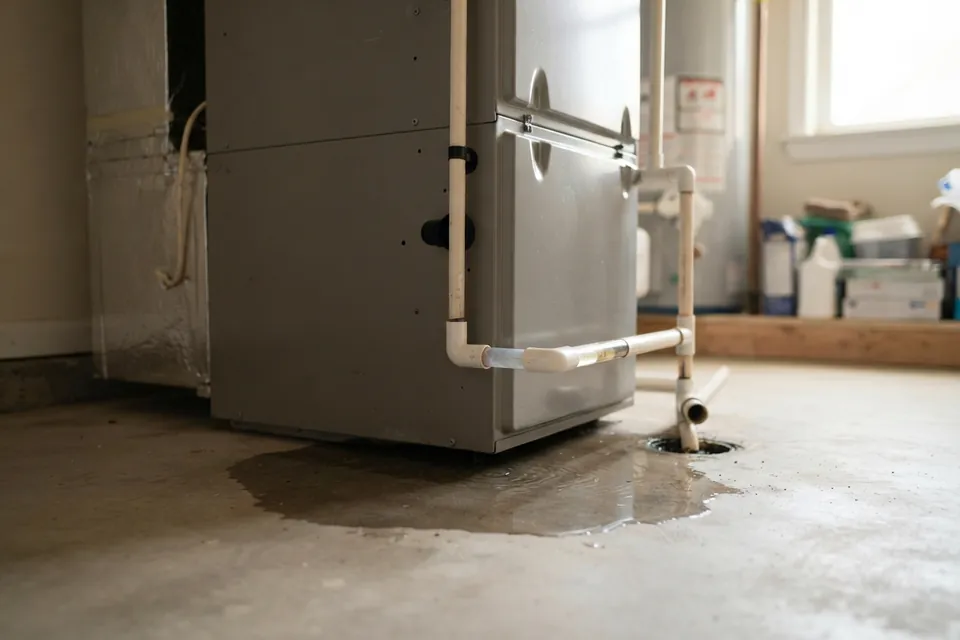
A puddle at the indoor unit is nearly always condensation that failed to drain. Turn cooling off at the thermostat so no more water forms. Mop up, replace a dirty filter, and see whether the drain pipe outdoors is dripping. Water that returns, a stained ceiling or ice on the coil means it is time for an HVAC technician. Hissing or an oily film is a different fault. Call for that too.
Key facts
- First move
- Cooling off at the thermostat
- Contractor license
- H100 HVAC Contractor (Utah DOPL)
- Permit
- City requires one when an air conditioning system is installed or altered
- Water damage cleanup
- $650–$5,900, Angi's typical Salt Lake City range for water damage restoration
- License lookup
- secure.utah.gov/llv, or DOPL at 801-530-6628
What is it usually?
| Symptom | Likely cause | Your move |
|---|---|---|
| Puddle beside the furnace or air handler | Drain line plugged with slime or dust | Cooling off. Call for a drain clearing |
| Drip from a ceiling under an attic unit | Overflowing drain pan | Cooling off now. Bucket under it |
| Water plus frost on the coil or pipe | Iced coil thawing, often after a blocked filter | New filter. Fan on. Let it melt |
| Small steady drip outdoors from a plastic pipe | Normal drainage | Nothing. That pipe is doing its job |
| Water only on humid, long-running days | Pan or line partly blocked | Book a service visit |
What can you safely check yourself?
- Stop making water. Set the thermostat to Off. Condensation only forms while the system cools.
- Soak it up. Towels, a mop or a wet-vac. Get stored boxes and rugs off the wet floor. Keep cords and power strips dry.
- Look at the filter. A filter packed with dust lets the coil freeze. Then the ice melts all at once. Change it.
- Find the drain outlet. A white plastic pipe usually ends outside near the foundation or at a floor drain. Was it dripping while the AC ran? A dry outlet on a running system points to a blockage.
- Watch for a restart. After the area is dry, some systems simply won't turn back on. Many have a float switch that cuts cooling when the pan fills. That is the safety working. It still needs a technician.
When should you stop and call a pro?
- Water shows up again within a day of drying.
- A ceiling is stained, soft or sagging.
- You see ice, and it returns after a new filter.
- The pan is rusted through or cracked.
- You hear hissing or bubbling, or find an oily residue.
- Water has reached wiring, the furnace controls or an outlet.
Clearing the line from inside the unit means opening the cabinet. So does anything involving the coil. Leave both to a technician. Skip the chemical drain cleaners as well.
Want a price for your home? Call a local heating & cooling pro for a written quote.
Phone line opening soonWhy does a Salt Lake City AC make this much water?
Cooling pulls moisture out of indoor air, and the moisture has to go somewhere. The airport's normal July high is 94 °F on NOAA's 1991-2020 figures, so systems here run long hours in midsummer. Long hours mean more condensation through the same small drain. A line that copes in June can fall behind in July.
Does clearing a drain need a permit?
Salt Lake City's permit FAQ talks about installing or altering heating, ventilation, and air conditioning systems. It does not mention cleaning or drain service. This guide has no city statement saying routine maintenance needs one. If the visit turns into a new coil, a new pan with re-piping or a replacement unit, ask about the permit then. The city's FAQ is the place to read the wording.
Who is allowed to do the work?
Utah issues an H100 HVAC Contractor license through DOPL. Confirm it yourself on the DOPL Licensee Lookup. If you prefer the phone, DOPL answers at 801-530-6628.
What does the repair cost?
There is no verified local price for a drain clearing or pan replacement in this guide. Ask for a flat written price. If the leak soaked drywall, carpet or a ceiling, cleanup is a separate bill. Angi's typical Salt Lake City range for water damage restoration is $650 to $5,900. For the drying side, see water damage first steps.
Will insurance pay for the water damage?
It depends on your policy and on how the damage happened. This guide has no Utah rule on AC leaks specifically. Photograph the wet area before you clean. Then ask your insurer. If a claim stalls, the Utah Insurance Department's consumer line is 801-957-9200 in the Salt Lake City area, or 1-800-439-3805 toll-free in Utah, 8:00 a.m. to 5:00 p.m. Monday to Friday.
What a repair usually costs
National ranges from cost publishers, not Salt Lake City quotes. The fault decides the price, so ask for it in writing before work starts.
When you call: 4 questions to ask
- Is the diagnostic or trip fee credited toward the repair?
- Will you size a new system with a load calculation rather than the old unit's size?
- Will you pull the Salt Lake City permit, and what's your Utah DOPL license number?
- Does this equipment qualify for an Enbridge Gas Utah or Rocky Mountain Power rebate, and who files it?
A fair written quote shows model numbers and efficiency, the permit and inspection, removal of the old unit, and parts and labor warranty. Check any contractor's license on Utah's DOPL lookup before work starts.
What happens when you call
- You're connectedStraight to a local heating & cooling pro that serves your area and takes calls like yours.
- You get a priceDescribe the problem, ask for a written quote and their license number. No obligation.
Common questions
Is it normal for an AC to leak water inside?
No. Dripping from the drain pipe outdoors is normal. Water on the floor or ceiling indoors means the condensation is not draining the way it should.
Can I still run my AC if it is leaking water?
Better not. Every hour of cooling adds water. Switch cooling off, dry the area and have the drain looked at.
Why is there ice on my AC and water on the floor?
Low airflow, often from a clogged filter, lets the coil freeze. When the ice melts it can overflow the pan. Change the filter and run the fan only. If ice returns, call.
Who fixes a leaking AC in Salt Lake City?
An HVAC contractor. In Utah the license classification is H100 HVAC Contractor, searchable on the DOPL lookup.
Related guides
Sources
- NOAA NCEI: 1991-2020 monthly climate normals, Salt Lake City International Airport
- Salt Lake City Building Services: Frequently asked questions
- Utah Division of Professional Licensing: Apply for a general contractor license
- Utah Division of Professional Licensing: Licensee Lookup & Verification System
- Angi: Water removal and recovery cost in Salt Lake City, UT
- Utah Insurance Department: Complaints
Costs are typical ranges. Your quote depends on your home. Rules and rebates change; check the original source before you rely on a figure. Something wrong? Tell us via the contact on the Impressum page.